
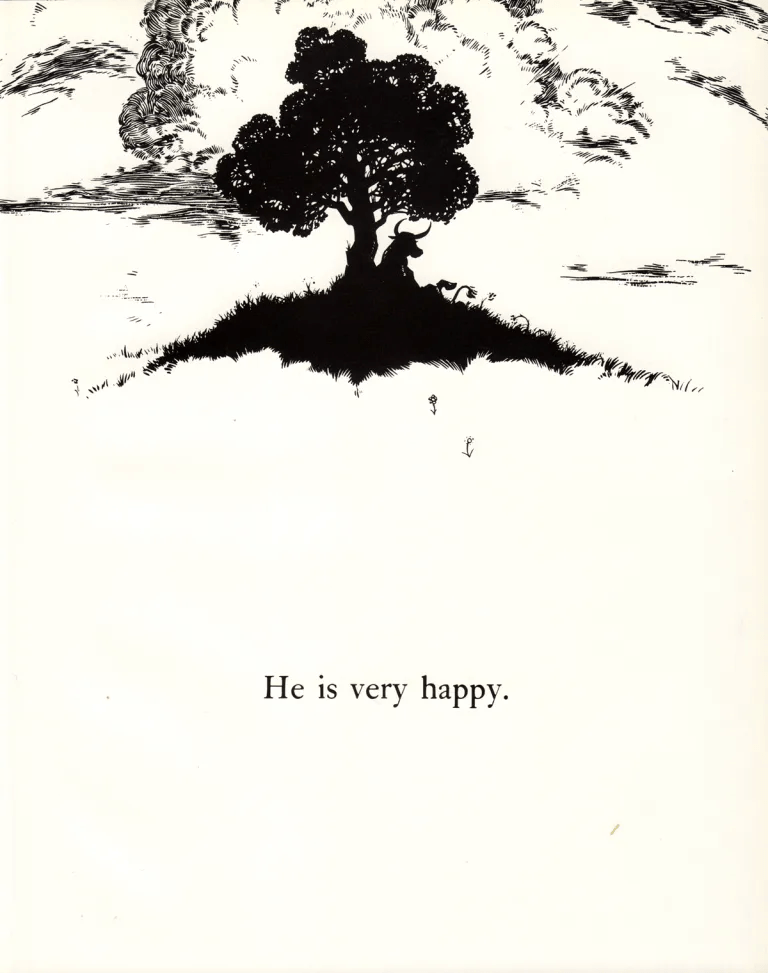
One thing I looked forward to when expecting my first child was poring through books and captivating my little one with adventure-bound stories and infecting him with my love of reading. That is, until my husband and I discovered how many poorly written children’s books exist (note to self: learn how to write a children’s book). So when we would come across a beautiful story, it really stood out, and one of those books for me is The Story of Ferdinand. Ferdinand is a courageous little bull who loves to sit under his favorite cork tree and smell the flowers, but is seen as an outsider because all of the other little bulls he grows up with love to run around, snorting and butting their heads, fighting literally and figuratively for a chance to show off in the esteemed bull fights in Madrid. Included in the book is a short passage about how his mother initially worries about his being lonesome, but after having a heartfelt discussion with her son, she realizes that there is nothing to worry about so long as Ferdinand remains authentic and chooses his happiness over fitting in. Though misunderstood, Ferdinand ultimately triumphs because he stays true to himself and does not stray from what makes him happy.
As my son grew up, this story started to resonate with me on a different level. He was diagnosed with autism right around his 2nd birthday, and it was a diagnosis that changed everything, yet nothing, all at once. It is a family diagnosis that impacts every member of the family, and though it certainly doesn’t feel like it initially, it is one that changed us all for the better. But in those early days/weeks/months, a layer of fear and grief lay idly beneath the strong veneer we all tried to project. And like Ferdinand’s mother, I worried about his being lonesome or being seen as an outsider while the world around him whirred by him without any regard to his unique interests and needs. I so very badly wanted to protect my son from a world who may misunderstand my sweet darling child, this beautiful intelligent child who made me a mother, my little bull who had no interest in fighting, snorting and butting his horns with the other bulls around him.
Fast forward a few months later to a family outing at the children’s museum. I noticed a young boy, maybe 11 or 12 years old, who shared some of the characteristics as my son. I recognized the focus in his eyes as he studied a marble run and saw things that we didn’t see. The happy and excited hand flapping was a familiar bat signal to me. And without agenda or any foresight, I cautiously approached the mother. I told her I didn’t know what to say and I hadn’t come up to anyone like this before, but “you see…my little boy is autistic….and…” and through my tears and pounding heartbeat, she looked at me with kind eyes and gently said, “My son is too, and it will be okay.” The tears didn’t stop, but now from gratitude that I found another family like mine, and that I was welcomed with compassion. This mother, Rebecca, and I spoke for a few minutes, and I pointed my son out to her and half-humorously and half-sheepishly told her that he is the toddler by the water fountain who’s not playing with anything at the museum. Her face lit up when she saw his smile, and she then spoke the most powerful words that will stay with me for the rest of my days: “But he’s happy.”
So often when times are difficult, we yearn for a future version of ourselves to time travel back to us and assure us that things will be okay. But kind Rebecca and the story of Ferdinand serve as a reminder that if you dial down the outside noise and really pay attention, things are already okay. It is part of our job to make sure we help our children find their cork tree and smell the flowers.
But he is happy.
He is very happy.
 MY Ferdinand
Leave a comment